
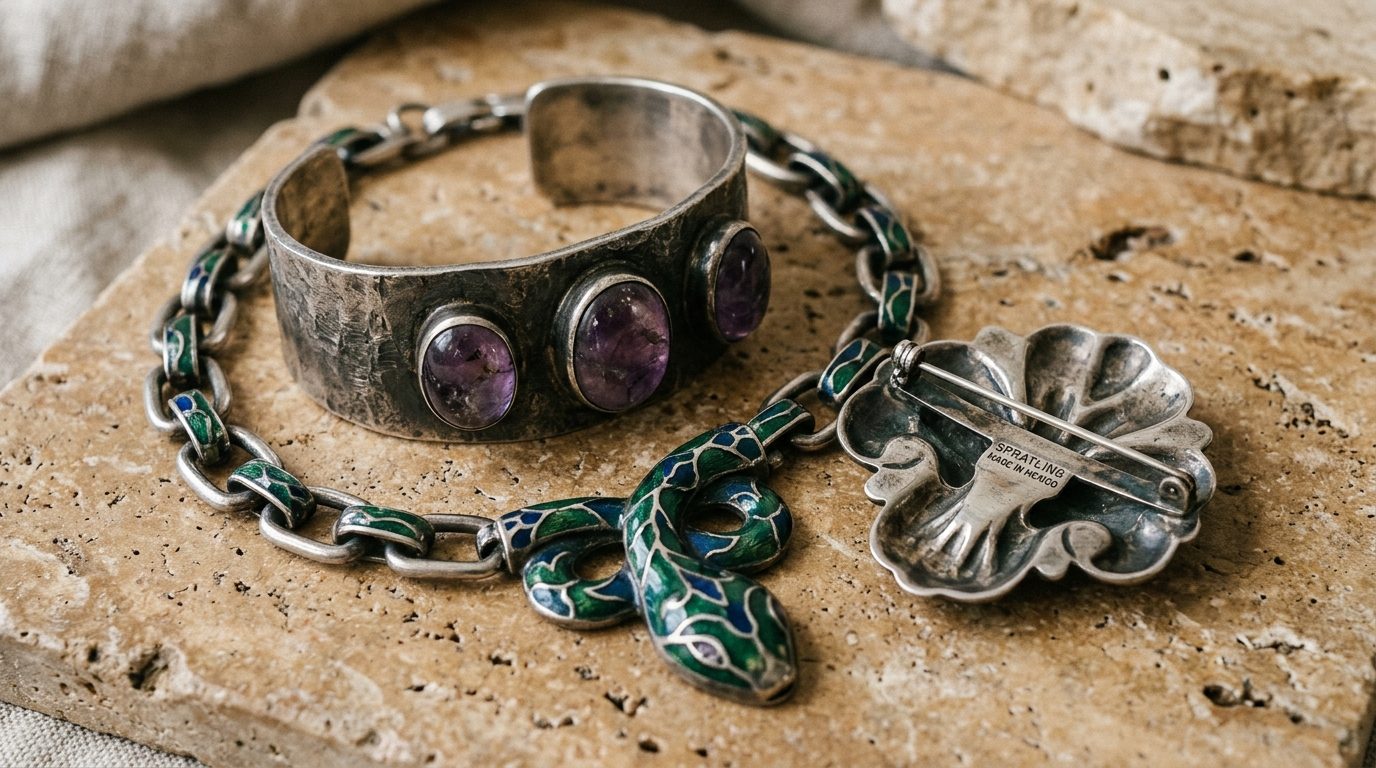
Vintage Taxco Silver: Masters, Marks & History
Tucked into the steep, sun-bleached hillsides of Guerrero, Mexico, the colonial city of Taxco de Alarcón feels like a living museum. With its narrow cobblestone streets, whitewashed adobe facades, and terracotta roofs, it is easy to see how this mountain enclave became the epicenter of twentieth-century silversmithing.
For many jewelry lovers, silver collecting begins with Southwestern Native American jewelry—the timeless pairing of heavy ingot silver, stampwork, and natural turquoise. Yet just across the border, another profound design revolution unfolded during the same era. Between the late 1920s and the 1960s, Taxco experienced a creative renaissance that drew artists, architects, and intellectuals from around the globe. The result was a body of wearable art that merged ancient Mesoamerican iconography with European Modernism and Art Deco fluidity.
Whether you are handling a substantial Spratling cuff or an articulated enamel collar by Margot de Taxco, holding a vintage Mexican studio piece offers a direct connection to a golden age of craftsmanship. Here is what every collector should know about the history, masters, and hallmarks of vintage Taxco silver.
The Spark of the Silver Renaissance
Taxco had been known for silver mining since the pre-Hispanic era, and later during the Spanish colonial period through the vast wealth of Don José de la Borda in the eighteenth century. However, by the early twentieth century, the town’s mines were largely depleted, and the local silversmithing tradition had dwindled to simple repair work and small religious trinkets.
Everything changed in 1929 with the arrival of William Spratling, an American architecture professor and writer from New Orleans. Spratling had fallen in love with Mexican culture while traveling with friend and artist Diego Rivera. Seeing the immense potential of local artisans, Spratling opened a small workshop in 1931 called Taller de Las Delicias.
Spratling did not simply import foreign designs; he looked deeply into Mexico's heritage. He studied Aztec, Mayan, and Mixtec motifs, blending pre-Columbian geometric forms with clean, modernist lines. He hired local craftsmen and established an apprenticeship system modeled after traditional European guilds, teaching young men how to cast, forge, chase, and finish fine silver.
Las Delicias became a fertile training ground. As gifted apprentices mastered the craft, they branched out to found their own talleres (workshops). Within two decades, Taxco was transformed from a quiet colonial outpost into the vibrant silver capital of the Americas.
The Great Maestros of Taxco
To understand Taxco silver is to become acquainted with the individual visionaries who shaped its visual language. While hundreds of independent artisans operated throughout the mid-twentieth century, a handful of names define the pinnacle of the movement.
William Spratling (1900–1967)
Affectionately known as El Padre de la Plata (The Father of Silver), Spratling set the standard for quality and aesthetic integrity. His work is recognized for its sculptural density, thoughtful proportions, and harmonious integration of native Mexican materials—such as rosewood, ebony, amethyst, jasper, and tortoise shell—set directly into heavy sterling silver. Spratling pieces feel remarkably substantial in the hand, characterized by a smooth, buttery hand-finish that cannot be replicated by modern machine polishing.
Margot van Voorhies Carr (Margot de Taxco)
Originally an American artist, Margot arrived in Taxco in 1937 and married Antonio Castillo of Los Castillo. After their divorce in 1948, she opened her own studio, signing her pieces "Margot de Taxco." Margot was a master of Champlevé enamel on silver, producing intricate, vibrant designs inspired by Japanese florals, astrological signs, ribbon motifs, and Mayan mythology. Her articulated snake and fish necklaces, which drape fluidly along the collarbone, remain among the most sought-after collector pieces in the world.
Los Castillo
Founded by four brothers—Antonio, Jorge, Justo, and Miguel Castillo—who trained under Spratling, the Los Castillo workshop was celebrated for boundless technical experimentation. They pioneered metales casados (married metals), a complex technique where different metals (sterling silver, copper, brass, and bronze) are inlaid together seamlessly without solder seams. They also mastered plata azul (blue silver) and feather mosaics set under rock crystal.
Antonio Pineda (1919–2009)
Perhaps the most purely modernist of Taxco’s masters, Pineda was an internationally acclaimed artist whose jewelry was showcased at the Palace of Fine Arts in San Francisco. Pineda’s work is architectural, bold, and fiercely clean-lined. He developed patented hinge systems and specialized in tension-mounted gemstones—such as moonstone, onyx, and amethyst—where the stones appear to float between heavy arcs of polished silver.
Héctor Aguilar
Another distinguished alumnus of Spratling's workshop, Aguilar established Taller Borda in 1939. His designs are recognizable by their bold, stylized hand-hammered surfaces, use of thick silver wire, and decorative functional rivets. Aguilar used a slightly higher purity of silver (often .940 or .990) during his early years, lending his jewelry an unmistakable soft, luminous luster.
Decoding Taxco Hallmarks and Assay Marks
Evaluating vintage Mexican silver requires a working understanding of the country's stamping laws, which changed significantly over the twentieth century. These marks provide vital clues to a piece’s age and origin.
1. Pre-1948 Hallmarks
Before 1948, silver stamping in Mexico was largely unregulated. Pieces from this era typically feature simple, hand-punched stamps including:
- The maker's name or workshop monogram (e.g., "Spratling Made in Mexico" or "Los Castillo / Taxco").
- A purity mark, such as "925" (sterling), "940", or "980" (a higher-purity alloy favored early on for its malleability and bright white tone).
- The town name: "Taxco" or "Taxco, Gro."
2. The Eagle Stamp Era (1948 to Late 1970s)
In 1948, the Mexican government instituted the "Eagle" assay mark to verify silver purity and promote export quality. The mark depicts a stylized eagle silhouette with a number stamped on its chest, which corresponded to a specific maker, workshop, or geographic location.
- Eagle 1: Often associated with Mexico City or specific master workshops.
- Eagle 3: Associated with William Spratling.
- Eagle 16: The hallmark assigned to Margot de Taxco.
- Eagle 15 and 20: Used by Los Castillo.
- Eagle 13: Héctor Aguilar.
Note on Variation: Small workshops occasionally shared assay marks, and stamps were frequently re-struck as dies wore down. An eagle mark is a reliable indicator that a piece dates between 1948 and 1979.
3. The Modern Registry System (Post-1979)
Around 1979–1980, Mexico replaced the eagle stamp with a standardized alphanumeric code consisting of two letters, a hyphen, and a registration number (e.g., TC-45 or TM-120).
- The first letter indicates the location (e.g., T for Taxco, M for Mexico City, G for Guadalajara).
- The second letter represents the initial of the artisan's first or last name.
- The number is the unique registration number of that silversmith.
Pieces bearing this alphanumeric code are modern or late-vintage, dating from 1980 onward.
Evaluating Quality in Vintage Mexican Silver
When adding vintage Taxco jewelry to your collection, look closely at the details that set hand-wrought studio work apart from commercial reproductions:
- Weight and Articulation: True mid-century Taxco pieces were built without skimping on raw silver. Multi-link bracelets and collars should feel substantial and drape naturally over the wrist or neck. Look for tongue-in-groove box clasps that click shut securely with a satisfying snap.
- Enamel Condition: When inspecting vintage Margot de Taxco or enamel pieces from other mid-century studios, look for clarity, depth of color, and minimal loss. Because enamel is glass fused to metal, small flea bites or surface scratches near edges are common and tell the story of authentic wear, but extensive chipping can diminish value.
- Hand Finishing and Patina: Vintage Taxco silver was finished with intentional contrasts: deeply oxidized recesses that accentuate high-relief chasing, alongside softly gleaming high points. Beware of pieces that have been aggressively machine-dipped or over-polished, which strips away decades of beautiful, earned character.
A Living Legacy
Vintage Taxco jewelry occupies an essential place in the narrative of twentieth-century design. These pieces were not mass-produced in impersonal factories; they were born from close-knit studio workshops where masters and apprentices worked side-by-side with charcoal blocks, chasing hammers, and hand saws.
Whether worn as a bold statement piece with contemporary tailoring or treasured inside a curated collection, vintage Taxco silver remains unmatched in its warmth, individuality, and sculptural presence. Each hallmark stamped on the reverse is not just a mark of purity—it is a signature of Mexico’s most brilliant artistic renaissance.
Related Reading
 Provenance Stories
Decoding Vintage Silver Hallmarks & Artisan Stamps
Learn how to read sterling silver hallmarks, maker's marks, and Southwestern artisan stamps to discover the quiet history behind your vintage jewelry.
 Provenance Stories
Vintage Southwestern Silver: Navajo, Zuni & Hopi
Learn to identify authentic vintage Southwestern jewelry. Explore Navajo stampwork, Zuni inlay, Hopi overlay, and Kewa heishi in our collector's guide.
 Care Guides
Real vs. Fake Turquoise: Spotting Authentic Stones
Learn how to spot genuine turquoise in vintage jewelry. Explore matrix cues, luster, weight, and safe at-home tests to identify real vs. imitation stones.