
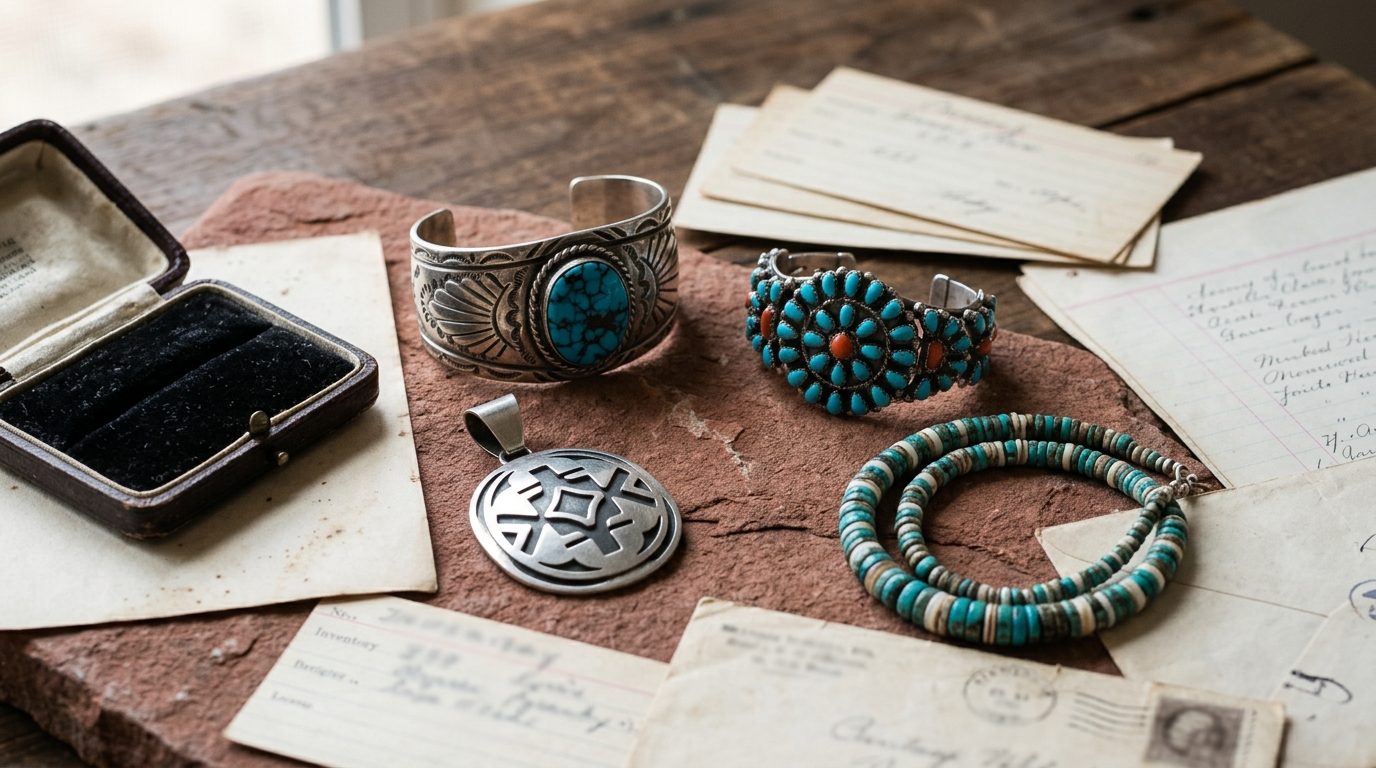
Vintage Southwestern Silver: Navajo, Zuni & Hopi
The Soul of the American Southwest in Sterling Silver
There is an undeniable presence to authentic vintage Southwestern sterling silver. When you slip a mid-century sandcast cuff over your wrist or turn a heavy bezel-set turquoise ring in your hand, you feel more than the cool density of precious metal. You feel weight, purpose, and the indelible touch of an artisan’s hand.
For generations, the Indigenous peoples of the American Southwest—most notably the Diné (Navajo), the A:shiwi (Zuni), the Hopi, and the Puebloans of Kewa (Santo Domingo)—have shaped silver and raw stone into one of the world's most recognizable and revered artistic traditions. While these traditions developed within neighboring desert landscapes, each culture forged its own distinct visual language, technical mastery, and philosophical approach to jewelry making.
For the discerning collector, navigating the world of vintage Southwestern jewelry requires both an appreciative eye and forensic curiosity. How do you distinguish between a Diné stamped cuff and a Hopi overlay piece? What separates Zuni needlepoint from petit point? And how can you verify authenticity in a marketplace clouded by modern imports and industrial castings?
This definitive guide breaks down the distinguishing characteristics, techniques, historic hallmarks, and turquoise varieties of Southwestern jewelry, offering you the foundational knowledge needed to build an extraordinary, heirloom-quality collection.
Navajo (Diné) Silversmithing: Weight, Stampwork, and the Power of Repoussé
The Diné were the first among the Southwestern tribes to adopt silversmithing. Around the late 1850s to 1860s, a Navajo blacksmith named Atsidi Sani learned metalworking from Mexican smiths (plateros). Early Diné artisans melted down Mexican silver pesos and American commercial silver dollars, hammering ingots into sturdy bracelets, bridle ornaments, and conchos.
Navajo aesthetics are historically grounded in celebrating the raw mass and sculptural authority of the metal itself, using turquoise not to crowd the silver, but to anchor its geometry.
Hallmark Characteristics of Vintage Navajo Jewelry
- Heavy-Gauge Silver & Ingot Construction: Early-to-mid-20th-century Navajo cuffs, buckles, and rings carry substantial weight. Before commercial mill-rolled sheet silver became widely available, smiths melted silver in crucibles and hand-forged ingots, leaving subtle organic thickness variations and micro-irregularities that modern machine stamping cannot replicate.
- Hand-Cut Steel Stampwork: Navajo smiths carved their own steel dies from hardened railroad spikes, files, or rebar. These stamps—depicting sunbursts, rain clouds, feathers, mountain peaks, and geometric tracks—were hand-struck into the silver. When evaluating authentic vintage stampwork, look closely at the impressions: depth should vary minutely across the piece, revealing the rhythmic strike of an artisan's hammer rather than the uniform depth of a hydraulic factory press.
- Repoussé and Chasing: In repoussé work, the artisan hammers the reverse side of the metal sheet to create raised, three-dimensional domes, lozenges, or fluted shells, subsequently detailing the front through chasing. This technique lends monumental dimensionality to classic mid-century concho belts and oversized rings.
- Sandcasting and Tufa Casting: A signature Diné technique dating back to the late 19th century, tufa casting involves carving an intricate negative mold into porous volcanic tufa stone (or compacted sand). Molten silver is poured into the mold. The resulting jewelry displays an unmistakable, granular, sandstone-like texture on its unpolished surfaces, often seen in openwork naja pendants and broad, sculptural cuffs.
- Bezel Settings and Twisted Wire: Navajo stones are traditionally secured in heavy, hand-toothed or serrated bezels, frequently framed by hand-twisted rope wire (carinated or rope borders) and hand-dropped silver raindrops (shot beads).
Zuni Lapidary Excellence: Precision Inlay, Needlepoint, and Petit Point
While Diné silversmiths prioritized heavy metalwork and bold, singular stones, the Zuni (A:shiwi) people approached jewelry from their deep-rooted legacy as master lapidaries. Long before silver was introduced, Zuni craftspeople were revered across trade routes for their delicate stone and shell carvings, fetish figures, and beadwork.
When Zuni smiths adopted silversmithing in the 1870s—learning initially from Navajo smiths like Lanyade—they quickly transformed silver into a structural framework designed to elevate microscopic stonecutting.
The Three Pillars of Vintage Zuni Stonecraft
1. Needlepoint
In genuine needlepoint jewelry, every individual stone is hand-cut and ground into a very thin, elongated oval with sharp, pointed ends on both sides. Each stone is set into its own miniature, hand-soldered sterling silver serrated bezel. A single vintage Zuni cluster cuff may feature dozens—sometimes hundreds—of identically matched turquoise needles, arranged in sunbursts, tiered halos, or floral clusters.
2. Petit Point
Similar to needlepoint, petit point refers to tiny stones hand-shaped into round, oval, teardrop (pear), or square forms. While needlepoint requires pointed tips at both ends, petit point stones typically feature one rounded end and one pointed end (teardrop) or rounded contours. The sheer patience required to cut, polish, and bezel-mount fifty to eighty matched stones across a single vintage ring or pin is the hallmark of mid-century Zuni craftsmanship.
3. Channel Inlay and Mosaic Inlay
Zuni lapidaries are renowned for channel inlay, wherein stones are precisely ground to sit flush against one another within silver channels (partitions). Unlike modern commercial glued inlay, vintage Zuni channel inlay features silver divider wires separating each stone segment. Common materials include a classic Southwestern palette:
- Natural turquoise (from light green Royston to clear sky-blue Sleeping Beauty)
- Red Mediterranean coral
- Jet (lignite fossilized coal)
- Golden mother-of-pearl and spiny oyster (Spondylus)
Mosaic inlay differs in that stones are adhered tightly edge-to-edge without intermediate silver dividing wires, creating continuous pictorial scenes (such as Rainbow Man, Knifewing deities, or hummingbirds) or complex geometric kaleidoscope patterns.
Hopi Silvercraft: The Mastery of Dual-Layer Oxidized Overlay
The Hopi silversmithing tradition followed a distinct evolutionary path. While early 20th-century Hopi jewelry shared stylistic similarities with Navajo stamped silver, the late 1930s and post-WWII era marked a profound renaissance in Hopi jewelry design.
Through initiatives led by the Museum of Northern Arizona and the Hopi Silvercraft Cooperative Guild (founded by masters like Fred Kabotie), Hopi artisans intentionally departed from turquoise-heavy pieces to develop an elite, graphic, all-silver technique known as Hopi Silver Overlay.
How Authentic Hopi Overlay Is Created
- Two Identical Sheets of Sterling Silver: The artist begins with two separate sheets of heavy-gauge sheet silver.
- Hand-Cutting the Negative Design: On the top sheet, the artist traces intricate iconography—water serpents (Palulukon), migration spirals, kachina figures, corn stalks, clouds, and geometric clan motifs. Using a microscopic jeweler's saw, every void is cut entirely by hand.
- Sweat-Soldering: The cut top sheet is sweat-soldered onto the solid bottom sheet using silver solder and high-temperature torch work, fusing them into a single, cohesive plate.
- Chiseling and Matting: Through the cut-out windows, the exposed base sheet is meticulously textured using fine steel matting punches or chisels to create tiny geometric grooves or stippling.
- Oxidation and Polishing: The piece is treated with potassium sulfide (liver of sulfur) to deeply blacken the recessed bottom plate. Finally, the top surface is buffed to a lustrous satin or high-mirror finish. The contrast between the velvety, textured black background and the bright, smooth upper relief creates a striking visual depth found in no other jewelry tradition.
When handling vintage Hopi jewelry, authentic pieces exhibit precise saw lines without sloppy solder runs in the recessed corners, and uniform matting that catches light beneath the deep oxidation.
Kewa (Santo Domingo) Artistry: Hand-Rolled Heishi and Tabular Mosaic
Located along the Rio Grande in New Mexico, the Pueblo of Kewa (formerly Santo Domingo) holds what is arguably the oldest continuous lapidary tradition in North America. Long before Europeans brought silver, Kewa artisans were drilling and stringing shell and turquoise beads for ceremonial trade.
Kewa artists are celebrated worldwide for their mastery of Heishi (from the Kewa word meaning "shell") and expressive mosaic slab jewelry.
Recognizing Authentic Kewa Craftsmanship
- Hand-Rolled Heishi Beads: True vintage heishi consists of tiny discs of shell (such as olive shell, clam, or spiny oyster) and turquoise drilled through the center, strung on wire or sinew, and painstakingly rolled against a sandstone wheel (or grinding stone) until the beads form an impossibly smooth, flexible cylinder. When draped in your hands, authentic hand-rolled heishi feels like cool, supple silk, with fluid movement and no sharp, abrasive edges.
- Depression-Era "Thunderbird" Necklaces: During the Great Depression of the 1930s and 1940s, when commercial silver and gemstones were scarce and expensive, Kewa artisans demonstrated astonishing resourcefulness. They shaped scrap materials—discarded black phonograph records, red plastic automotive battery casings, combs, and gypsum—into vibrant mosaic thunderbird pendants backed with reclaimed wood or Bakelite. Today, these Depression-era Kewa necklaces are highly coveted museum-grade collectibles.
- Tabular Mosaic Drops: Traditional Kewa earrings and pendants feature large, polished slabs of olive shell or tabular cuts of turquoise layered with geometric mosaic inlays of jet, shell, and coral, suspended from natural cordage or sterling ear wires.
Southwestern Artistry at a Glance
| Tradition | Primary Focus | Signature Techniques | Classic Materials | Visual Aesthetic |
|---|---|---|---|---|
| Navajo (Diné) | Silver architecture & bold stone balance | Hand stamping, repoussé, sand/tufa casting, hand-cut bezels | Heavy sterling silver, turquoise, ingot coin silver | Bold, sculptural, dimensional, rugged elegance |
| Zuni (A:shiwi) | High-precision lapidary work | Needlepoint, petit point, channel inlay, mosaic inlay | Turquoise, Mediterranean coral, jet, mother-of-pearl | Intricate, geometric, kaleidoscope-like, delicate |
| Hopi | Graphic silver storytelling | Two-layer silver overlay, sweat-soldering, textured oxidation | Sterling silver (rarely accented with solitary stones) | Graphic, high contrast, clean architectural relief |
| Kewa (Santo Domingo) | Ancient beadwork & organic mosaic | Hand-rolled heishi, tabular slab mosaics, Depression-era assemblage | Shell, spiny oyster, turquoise, jet, reclaimed materials | Earthy, supple, flowing, ancestral purity |
The Geography of Stone: Recognizing Classic Southwestern Turquoise Mines
In vintage Southwestern jewelry, the stone tells a geological story as rich as the metal surrounding it. Because American turquoise occurs in arid, copper-rich deposit zones throughout Arizona, Nevada, New Mexico, and Colorado, different mines yield distinctly unique combinations of color, hardness, and matrix pattern. While non-destructive testing cannot definitively guarantee a mine source without provenance, experienced collectors look for classic visual profiles:
1. Bisbee (Arizona)
Renowned for its deep, rich "electric" royal blue hues, vintage Bisbee turquoise often contains a dramatic, smoky reddish-brown to dark chocolate matrix, sometimes referred to as "chocolate web." Mined primarily from the Lavender Pit copper mine, it remains among the rarest and most valuable stones in vintage Diné and Zuni jewelry.
2. Morenci (Arizona)
Famous for its vivid sky-blue to deep teal coloration, classic Morenci is celebrated for its distinctive matrix: shimmering, metallic iron pyrite (fool's gold). When polished, the pyrite inclusions gleam like silver veins running across a clear blue canvas.
3. Number 8 (Nevada)
Mined in Eureka County, Nevada, Number 8 turquoise is revered for its extraordinary golden-brown, red, or dark brown spiderweb matrix set against a powdery blue or mint-green background. Major production ceased in the mid-20th century, making vintage pieces set with natural Number 8 prime collector treasures.
4. Royston (Nevada)
The Royston mining district is legendary for its striking two-tone stones, where vibrant emerald greens and soft sky blues bleed into one another across a single cabochon, banded by rich golden-brown and ochre chert matrix.
5. Sleeping Beauty (Arizona)
Mined in Globe, Arizona, this stone is beloved for its clean, robin’s-egg blue color, historically exhibiting little to no matrix. It became the premier choice for Zuni needlepoint and petit point artisans throughout the 1960s through 1980s due to its uniform color consistency across dozens of tiny hand-cut settings.
The Hallmarks of Authenticity: Reading Signatures, Purity Marks & Patina
Understanding the timeline of Southwestern jewelry hallmarks is essential for identifying the era and authenticity of a piece:
1. The Pre-Hallmark Era (Late 1800s – 1930s)
Early vintage Southwestern jewelry was rarely signed or stamped with silver purity marks. Native smiths worked directly for family, trade, or local trading posts (such as Hubbell, Ganado, or C.G. Wallace). The absence of a "STERLING" or artist stamp on an early piece is not a red flag; rather, when paired with hand-hammered ingot silver, file marks, and early natural stones, it often signals significant age.
2. Trading Post and Guild Marks (1930s – 1950s)
In the 1930s, organizations like the Indian Arts and Crafts Board (IACB) introduced stamps (such as "US NAVAJO" followed by a number) to protect authentic Indigenous craft from cheap industrial imitations. The Hopi Silvercraft Guild introduced its iconic sun-face mark to signify Guild-approved overlay pieces. Trading posts also used stamped shop marks (such as the Bell Trading Post bell insignia or Maisel’s Indian Trading Post stamps) for bench-made items.
3. Artist Hallmarks and "STERLING" (1950s – Present)
Following the Indian Arts and Crafts Act movements and increased commercial retail presence, individual artists began signing their work using initials, full names, or pictographs (such as a feather, bear claw, or rain cloud), accompanied by standard "STERLING" or ".925" purity marks.
The Irreplaceable Truth of Natural Patina
True vintage silver develops an atmospheric, soft, dark-grey patina in its recesses and a warm, velvety glow on its raised surfaces—a finish born of decades of air exposure and gentle wear. Beware of pieces with harsh, unnaturally uniform chemical blackening across high-contact zones, or conversely, pieces that have been aggressively machine-polished to a sterile, mirror shine, which strips away historical character and dulls the crisp edges of vintage stampwork.
Spotting Reproductions: Real Craftsmanship vs. Modern Casting
As vintage Southwestern jewelry has grown in popularity, the market has seen an influx of overseas mass reproductions and machine-cast knockoffs. Here is how to inspect a piece with a collector's critical eye:
- Inspect the Reverse Side: Turn the cuff, pin, or ring over. Authentic handmade stampwork displaces silver, leaving subtle raised shadows or depressions on the reverse side corresponding to the front stamps. If a cuff features deep front stamping but the back is completely smooth, flat, and uniform, it was likely cast from a mold, not hand-stamped.
- Check the Bezels: Hand-fabricated bezels are made from thin silver strip metal wrapped around the specific stone and soldered closed with a visible seam. Cast fake settings often have thick, blunt, molded bezels with unnatural symmetry or stones glued into pre-formed trays with visible gaps.
- Evaluate Stone Backing and Stability: In vintage Zuni inlay and Navajo cabochons, stones were set by hand pressure using bezel lips, often seated on beds of fine sawdust, cardboard matchbook fragments, or shellac to level the natural stones. Modern commercial replicas frequently use synthetic turquoise blocks (plastic or dyed magnesite) adhered with industrial epoxies and cut with automated laser precision.
- Look for Tooling and File Marks: Authentic vintage jewelry contains subtle human imperfections: a slightly angled stamp strike, minute jeweler’s saw lines on the edges of an overlay motif, or hand-filed bevels along the terminal edges of a cuff. Machine-made reproductions often appear either artificially "perfect" or possess mushy, rounded details characteristic of low-pressure metal casting.
Caring for and Building a Curated Southwestern Collection
Building a collection of vintage Southwestern silver is an investment in wearable cultural art. To preserve your pieces for generations to come, proper stewardship is essential:
- Never Submerge Turquoise in Liquid Cleaners: Natural turquoise is a porous, hydrated copper-aluminum phosphate mineral. Chemical dips, ultrasonic cleaners, and harsh detergents will penetrate the stone, permanently altering its vibrant color to dull green or causing it to crack.
- Avoid Harsh Polishing Dips: Liquid silver cleaners strip away the intentional oxidation and historical patina that give Hopi overlay, Diné stampwork, and Zuni clusters their depth. Instead, use a dry, premium jeweler’s polishing cloth (such as a Sunshine cloth) to gently buff raised surfaces while leaving the darker recesses untouched.
- Store in Climate-Controlled Environments: Avoid damp bathrooms or humid basements. Store cuffs and delicate cluster rings in soft cloth pouches or lined jewelry trays away from direct sunlight.
- Buy Verified Provenance: When acquiring one-of-a-kind vintage jewelry, work with galleries that meticulously research and verify hallmarks, construction techniques, and stone authenticity.
Every vintage Southwestern piece carries a distinct voice from the high desert—a story captured in stamped silver, hand-ground turquoise, and meticulous overlay. Whether you are captivated by the bold architecture of a Diné ingot cuff, the dizzying precision of a Zuni needlepoint cluster, or the graphic depth of Hopi overlay, you are preserving a timeless chapter of American artistry.
Related Reading
 Provenance Stories
Navajo, Zuni, or Hopi? A Collector’s Guide
Learn how to identify vintage Navajo, Zuni, Hopi, and Santo Domingo jewelry through traditional lapidary arts, silver overlay, stampwork, and hallmarks.
 Provenance Stories
Beyond Turquoise: Southwestern Gemstones & Shells
Explore vintage Southwestern jewelry beyond turquoise. Discover the history and artistry of spiny oyster, jet, sugilite, and rare lapidary materials.
 Provenance Stories
Vintage Taxco Silver: Masters, Marks & History
Explore the Golden Age of vintage Taxco silver. Learn to decode eagle assay stamps, identify legendary makers, and collect authentic Mexican studio jewelry.