
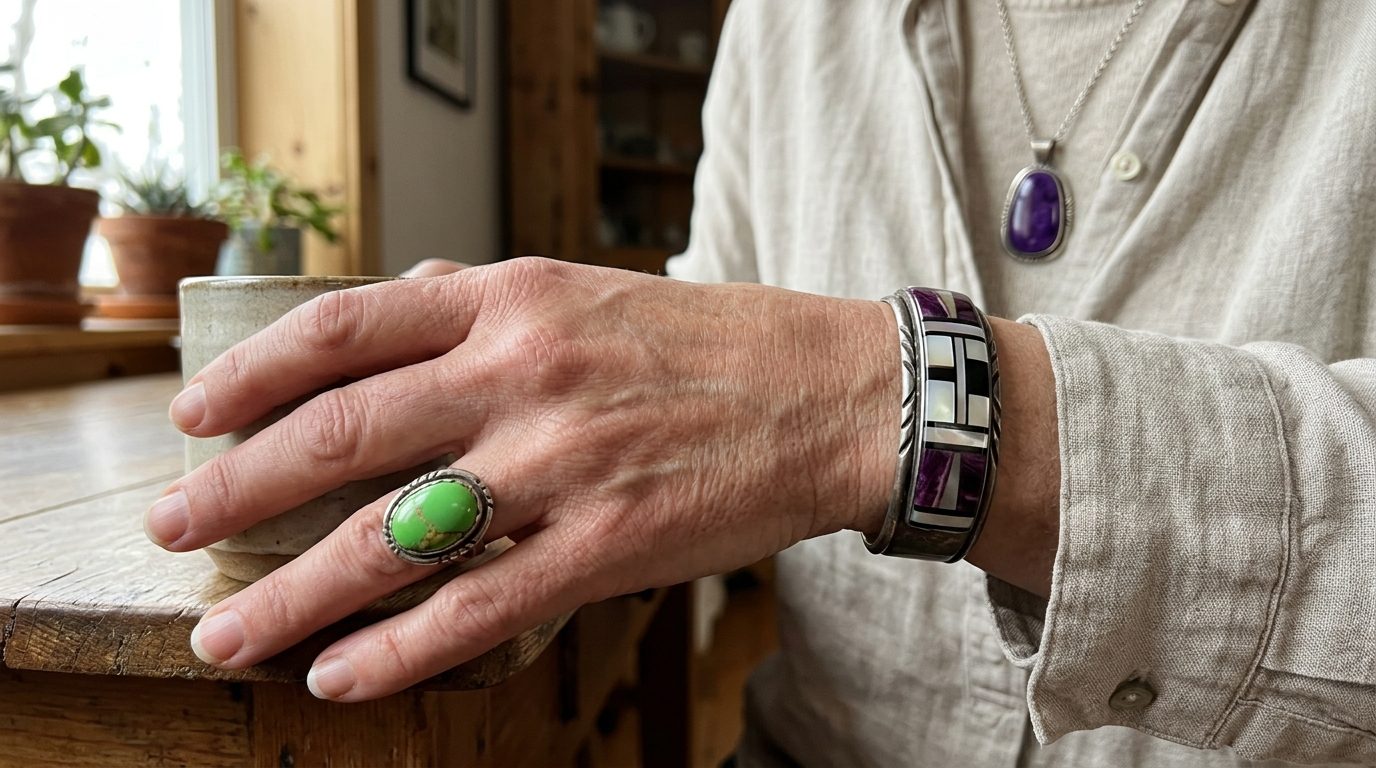
Beyond Turquoise: Southwestern Gemstones & Shells
When most collectors think of Southwestern Native American jewelry, the mind immediately conjures the breathtaking cerulean blues and earthy matrix of turquoise. For generations, turquoise has reigned as the quintessential stone of the American Southwest, revered across Navajo, Zuni, Hopi, and Pueblo cultures for its connection to the sky, water, and enduring blessings.
Yet, to view Southwestern lapidary traditions solely through the lens of turquoise is to overlook an astonishingly diverse palette of organic shells, rare minerals, and historic gemstones. For centuries, Indigenous artisans have gathered materials from coastal shorelines, volcanic vents, and high-desert plateaus—transforming natural minerals into wearable poetry.
For the discerning collector, stepping beyond turquoise reveals the true depth of Southwestern artistry. From the smoldering crimsons of spiny oyster shell to the deep midnight gloss of jet and the velvety royal purple of sugilite, here is your essential guide to the stones and shells that define the full spectrum of Southwestern vintage jewelry.
The Sacred Ocean: Spiny Oyster Shell (Spondylus)
Long before European contact, vibrant trade routes crisscrossed the Americas. Coastal shells were carried hundreds of miles inland from the Gulf of California and the Pacific coast of South America to trade centers like Chaco Canyon. Among the most prized of these marine treasures was Spondylus, commonly known as spiny oyster shell.
Unlike traditional mollusks, spiny oyster is characterized by prominent exterior spines and an interior rim that displays intensely saturated hues ranging from delicate peach and sunny marigold to fiery orange, rich crimson, and royal purple.
The Collector’s Eye
- Color Saturation: Natural red and deep purple specimens are rarer than orange or yellow tones and have historically commanded higher value.
- Artisanal Application: In vintage Navajo jewelry, spiny oyster is often set as bold, single cabochons framed by twisted wire and hand-stamped sterling silver. In Zuni work, it forms the vibrant red and orange petals in mosaic floral pins, cluster rings, and rainbow-hued sunface motifs.
- Natural Character: True vintage spiny oyster often exhibits subtle color striations, growth lines, and tiny natural pits, distinguishing it from reconstituted or dyed block alternatives.
Jet: The Midnight Foundation of Ancient Mosaic
Before silver arrived in the Southwest in the mid-19th century, Ancestral Puebloan jewelers created magnificent mosaic overlays by affixing tiny, hand-beveled tiles of turquoise, shell, and black stone onto backing pieces of wood, bone, or shell. That black stone was almost exclusively jet—or lignite, a dense, fossilized wood formed under immense pressure over millions of years.
Jet is lightweight, warm to the touch, and capable of taking an exceptional mirror polish. In Southwestern jewelry, it provides the vital contrasting element that makes brighter stones spring to life.
The Collector’s Eye
- Zuni Inlay Masterpieces: Jet is indispensable in Zuni channel and mosaic inlay, serving as the rich black background in depictions of the Rainbow Man, Knifewing deity, and geometric sun patterns.
- Sensory Identification: Authentic jet is remarkably lightweight compared to black onyx or obsidian. When gently rubbed against untreated fabric, it builds a subtle electrostatic charge.
Mother-of-Pearl & Abalone: The Iridescent Canvas
Where jet provides the deep shadows, mother-of-pearl (nacre) and abalone shell supply shifting, celestial light. Sourced from the interior lining of oyster, mussel, and abalone shells, these organic materials have been used in the Southwest for millennia.
While mother-of-pearl yields a smooth, creamy luminescence with gentle pink and mint overtones, Pacific abalone offers a dramatic swirling rainbow of blues, greens, and iridescent violets.
The Collector’s Eye
- Depth and Sheen: High-grade vintage mother-of-pearl displays uniform thickness and a deep, cloud-like iridescence without chalkiness.
- The Leekya Legacy: Celebrated Zuni master carver Leekya Deyuse (1889–1966) frequently used large portions of white shell and mother-of-pearl to carve exquisite animal fetishes, combining prehistoric carving methods with mid-century jewelry aesthetics.
The Green Spectrum: Variscite, Chrysocolla, and Gaspeite
While green turquoise holds a revered place among collectors, several distinct green minerals often share the spotlight—each with its own geological story.
Variscite
Often confused with high-grade green turquoise, variscite is a hydrated aluminum phosphate mineral prized for its cool mint, apple, and emerald hues. Mined extensively in Utah and Nevada (notably the Lucin and Fairfield deposits), variscite often features intricate black or golden-web matrices. It offers an earthy sophistication that pairs effortlessly with darkened vintage silver patina.
Chrysocolla
Found in rich copper deposits throughout Arizona, chrysocolla is a soft, sky-blue to vibrant cyan silicate mineral. It frequently forms in conjunction with malachite, quartz, and azurite, yielding multi-toned cabochons that resemble aerial views of earth and ocean.
Gaspeite
Introduced to Southwestern lapidaries in the late 20th century, gaspeite is a rare nickel carbonate mineral characterized by an unmistakable, electric neon-green color. Often found alongside brown magnesite matrix, it became a signature material for contemporary Southwestern artists seeking punchy, graphic contrast against purple sugilite and orange spiny oyster.
The Royal Purples: Sugilite and Charoite
In the 1970s and 1980s, a lapidary revolution swept through the Southwest. Pioneering Hopi artist Charles Loloma and his contemporaries broke away from strict traditionalism, introducing unconventional stones into gold and silver fabrication. Among the most iconic of these modern additions were sugilite and charoite.
- Sugilite (Wesselite): First discovered in significant gem-quality quantities in South Africa’s Kalahari Manganese Field in the late 1970s, sugilite spans shades from light lilac to deep, opaque royal purple and translucent "gel." Loloma and contemporary Navajo masters embraced sugilite, creating museum-worthy cuffs and rings that bridged ancient channel inlay techniques with high fashion.
- Charoite: Mined exclusively along the Chara River in Siberia, charoite features swirling, silky patterns of lavender, lilac, and violet. Its chatoyancy (cat's-eye effect) gives vintage late-century Southwestern jewelry dynamic visual movement.
Monochromatic Elegance: White Buffalo and Wild Horse
In recent decades, collectors have fallen in love with high-contrast, black-and-white stones frequently marketed under romantic trade names. Understanding what these stones actually are is key to building an authentic collection.
White Buffalo
Originating from the Tonopah region of Nevada, White Buffalo is often colloquially called "white turquoise," though technically it is not turquoise at all. Geologically, it is a mixture of calcite, dolomite, and chert, characterized by striking stark white bodies interwoven with deep black chert matrix. Because it occurs in the same geological veins as turquoise, it has earned an honored place in modern Southwestern jewelry design.
Wild Horse (Crazy Horse)
Mined near the Gila Wilderness in Arizona, Wild Horse is a natural stone composed of magnesite and hematite. It displays creamy off-white and beige fields marbled with rich reddish-brown, copper, and mahogany veining.
The Master Art of Inlay: Mosaic, Channel, and Micro-Inlay
To appreciate these stones fully, one must understand how Indigenous lapidaries assemble them into harmonious works of art. The Zuni Pueblo, in particular, elevated stone inlay into an internationally celebrated art form.
- Mosaic Inlay: Stones are shaped and adhered directly against one another over a silver base without individual metal dividers, creating a continuous, painterly picture or pattern.
- Channel Inlay: Silver wire "channels" are soldered onto a baseplate, and precisely cut stones are individually set and leveled flush within each silver cell. This technique requires mathematical precision; each stone must be hand-beveled to seat securely.
- Micro-Inlay: Pioneered in the latter half of the 20th century by master artists such as Wes Willie and the late Gibson Nez, micro-inlay involves setting hundreds of microscopic slivers of stone, shell, and precious metals into breathtaking multi-dimensional landscapes.
Caring for Multi-Stone Vintage Jewelry
Because Southwestern jewelry often pairs stones of drastically different hardness levels—such as delicate mother-of-pearl (Mohs 3.5) with harder variscite (Mohs 4.5–5) and quartz-rich stones—care and cleaning require a gentle touch.
- Never Submerge in Liquid Cleaners: Vintage mosaic and channel inlay pieces often rely on traditional pine pitch, hide glue, or jewelry epoxy beneath the stones. Soaking them in water or chemical dips will loosen the bonding agent and cause stones to lift.
- Avoid Ultrasonic and Steam Machines: The rapid vibrations and high heat of ultrasonic cleaners will shatter soft stones like jet, crack fragile shell, and destroy organic binders.
- Use a Dedicated Polishing Cloth: To restore shine to the silver without harming the stones, use a two-ply treated polishing cloth (such as a Sunshine cloth). Polish only the high points of the silver, leaving the natural oxidation in the recesses to preserve the vintage depth and contrast.
- Wipe Clean After Wear: Natural oils, perfumes, and cosmetics can dull the surface of organic shells and porous stones. Wipe your jewelry with a soft, dry microfiber cloth after wearing before returning it to a cool, dry jewelry box.
The Joy of the Diverse Southwestern Palette
Collecting vintage Southwestern jewelry is an exploration of geography, history, and extraordinary lapidary skill. While turquoise will always remain an enduring icon of the Southwest, widening your gaze to include spiny oyster, jet, variscite, and sugilite opens an entirely new dimension of appreciation.
Each stone carries a whisper of its origin—from ocean floors to desert mountain ranges—brought together by the hands of master artisans into wearable heirlooms that tell a truly timeless American story.
Related Reading
 Provenance Stories
Vintage Southwestern Silver: Navajo, Zuni & Hopi
Learn to identify authentic vintage Southwestern jewelry. Explore Navajo stampwork, Zuni inlay, Hopi overlay, and Kewa heishi in our collector's guide.
 Provenance Stories
Navajo, Zuni, or Hopi? A Collector’s Guide
Learn how to identify vintage Navajo, Zuni, Hopi, and Santo Domingo jewelry through traditional lapidary arts, silver overlay, stampwork, and hallmarks.
 Care Guides
Real vs. Fake Turquoise: Spotting Authentic Stones
Learn how to spot genuine turquoise in vintage jewelry. Explore matrix cues, luster, weight, and safe at-home tests to identify real vs. imitation stones.