
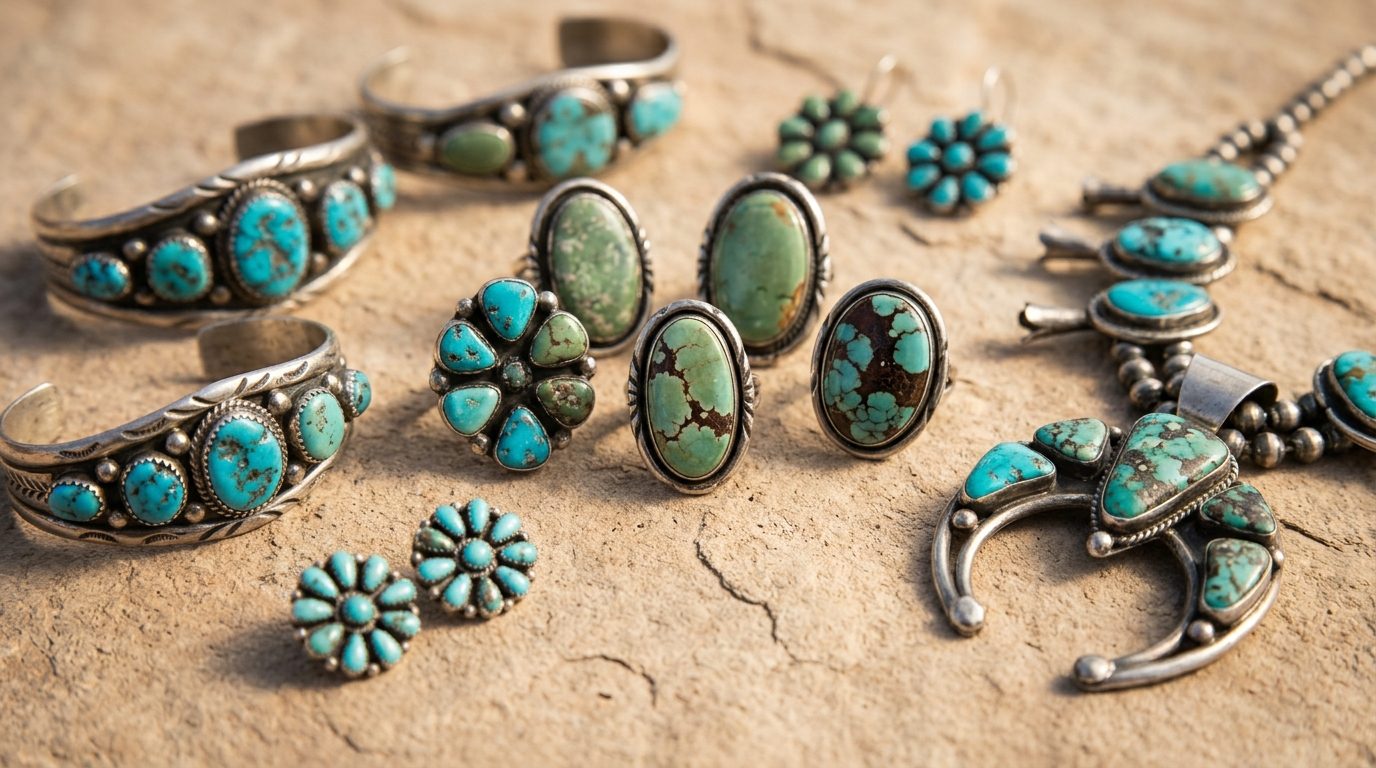
Real vs. Fake Turquoise: Spotting Authentic Stones
For centuries, turquoise has held a sacred place in jewelry making. From ancient talismanic amulets to the intricate, bold silversmithing of twentieth-century Diné (Navajo), Zuni, and Hopi artisans, this sky-stone carries an enduring charm. Yet because genuine turquoise is formed through rare geological circumstances—percolating groundwater leaching copper and aluminum through host rocks over millions of years—it is both scarce and frequently imitated.
Whether you are browsing an estate sale or evaluating an heirloom passed down through generations, knowing how to discern authentic turquoise from modern imitations is essential. Here is a guide to understanding the spectrum of turquoise, recognizing telltale visual and tactile clues, and conducting safe, non-destructive tests at home.
Understanding the Spectrum of Turquoise
Before determining whether a stone is "real," it helps to know that turquoise exists on a spectrum of treatment rather than a strict binary of genuine versus fake.
1. Natural Turquoise
Natural turquoise is untreated stone that has been mined, cut, shaped, and polished without any chemical altering, resin infusion, or dyeing. Only a small percentage of mined turquoise is dense enough to be cut raw without crumbling. Over decades of wear, natural turquoise absorbs skin oils and environmental moisture, slowly developing a richer, darker patina that tells the story of its wearer.
2. Stabilized Turquoise
Turquoise is naturally porous. In stabilized turquoise, low-grade, chalky natural turquoise is infused under pressure with a clear polymer resin or epoxy. This process hardens the mineral so it can be cut and set into silver without fracturing, while sealing in its color. Stabilized turquoise is still genuine stone—and widely accepted in both vintage and contemporary jewelry—but it should be valued differently than high-grade natural material.
3. Reconstituted (Chalk) Turquoise
Reconstituted stone is made from leftover turquoise dust, fragments, and chalky scraps pulverized and bound together with synthetic resins and artificial dyes. While it contains actual turquoise particles, it is essentially a composite material manufactured to mimic solid gemstone.
4. Block Turquoise and Synthetics
"Block" turquoise contains no genuine turquoise at all. It is typically dyed plastic resin, porcelain, or alternative minerals such as howlite or magnesite that have been saturated with vivid blue dye. Dyed howlite is the most prevalent imitation found in low-cost and vintage-replica jewelry.
Visual Clues: Matrix, Color, and Surface Luster
Your eyes are your best initial tool. Natural gemstones have organic irregularities that industrial manufacturing cannot replicate faithfully.
Look Closely at the Matrix
The matrix—the dark web-like veins or patches traversing a stone—is the host rock (such as limonite, sandstone, or quartz) in which the turquoise formed.
- In natural stones: The matrix varies organically in depth, texture, and color, ranging from deep chocolate brown and charcoal black to rusty ochre and golden sand. Under a magnifying glass, you may notice tiny natural pits or uneven planes where the matrix meets the turquoise.
- In imitations: Dyed howlite often features dark gray or black matrix lines where the dye has pooled heavily into the natural crevices of the host mineral. In plastic block turquoise, matrix patterns frequently look drawn-on, stamped, or unnaturally uniform, lacking natural dimensional depth.
Analyze the Color Distribution
Natural turquoise spans an incredible spectrum: robin's egg blue from Arizona's Sleeping Beauty mine, electric blues with black matrix from Kingman, and deep mossy greens from Nevada's Royston and Carico Lake deposits. However, natural color is rarely flat. Look for subtle tonal gradations, microscopic variations, and translucent depths across the cabochon. If a stone exhibits a shockingly uniform, saturated neon cyan without any variation, it warrants closer inspection.
Check the Luster
Natural turquoise polished on a lapidary wheel exhibits a gentle, waxy-to-subvitreous luster. Imitation block turquoise often presents a glassy, ultra-reflective sheen or, conversely, a flat, dull plastic surface that lacks mineral depth.
Tactile Clues: Weight and Temperature
Our hands can often sense subtle differences that our eyes might miss.
The Temperature Test
Real minerals conduct heat differently than plastics. When you first pick up a piece of authentic turquoise jewelry that has been resting at room temperature, the stone will feel cool against your fingertips or pressed gently to your cheek. Genuine stone slowly warms to your body heat. Plastic block imitations feel instantly warm or room-temperature upon contact.
Heft and Density
Turquoise is a relatively dense mineral with a specific gravity of roughly 2.60 to 2.90. Synthetic resin block is significantly lighter. If an oversized statement ring or cluster cuff feels feather-light in your palm—even accounting for the silver setting—the stones may be hollow or composite resin.
Safe, Non-Destructive Tests for Vintage Settings
Traditional folklore often suggests using a red-hot pin or swabbing stones with acetone to detect synthetic resins. Never use destructive tests on vintage or heirloom jewelry. High heat can crack natural turquoise, scorch silver bezels, and melt resin out of stabilized stones, irreversibly devaluing a rare piece.
Instead, rely on these gentle, non-invasive methods:
1. The 10x Jeweler's Loupe
A 10x triplet loupe is an invaluable investment. Under magnification, look for:
- Dye pooling: In dyed howlite or magnesite, blue pigment concentrates in micro-fractures, creating dark, intense blue seams.
- Air bubbles: Synthetic resins and glass imitations often trap microscopic spherical air bubbles beneath the surface.
- Surface wear: Natural turquoise shows fine, organic hairline scratches from decades of gentle wear, whereas soft plastic blocks often show gouges or a rubbery edge around the bezel setting.
2. The Gentle Tap
Lightly tap the stone against a clean ceramic plate or the edge of your tooth. Genuine stone produces a crisp, solid "clink" characteristic of mineral rock. Plastic and resin composites produce a dull, muted "thud."
Evaluating the Setting and Provenance
A gemstone should always be evaluated in the context of the piece housing it. Fine, natural turquoise is rarely set into cheap base metals. Look for hallmarks such as STERLING or .925, hand-stamped artisan signatures, or shop marks typical of mid-century Southwestern silversmithing.
Examine the bezel: authentic vintage Southwestern pieces frequently feature custom, hand-formed saw-tooth or smooth silver bezels tailored to the exact, uneven silhouette of each hand-cut cabochon. Imitation jewelry made for mass production often relies on uniform, factory-stamped settings glued loosely around calibrated plastic stones.
By taking the time to read the matrix, feel the stone's natural cool weight, and appreciate the craftsmanship of the setting, you can collect and preserve vintage turquoise with confidence—honoring both the geological wonder of the stone and the artisans who shaped it.
Related Reading
 Provenance Stories
Vintage Southwestern Silver: Navajo, Zuni & Hopi
Learn to identify authentic vintage Southwestern jewelry. Explore Navajo stampwork, Zuni inlay, Hopi overlay, and Kewa heishi in our collector's guide.
 Provenance Stories
Beyond Turquoise: Southwestern Gemstones & Shells
Explore vintage Southwestern jewelry beyond turquoise. Discover the history and artistry of spiny oyster, jet, sugilite, and rare lapidary materials.
 Provenance Stories
Vintage Taxco Silver: Masters, Marks & History
Explore the Golden Age of vintage Taxco silver. Learn to decode eagle assay stamps, identify legendary makers, and collect authentic Mexican studio jewelry.