
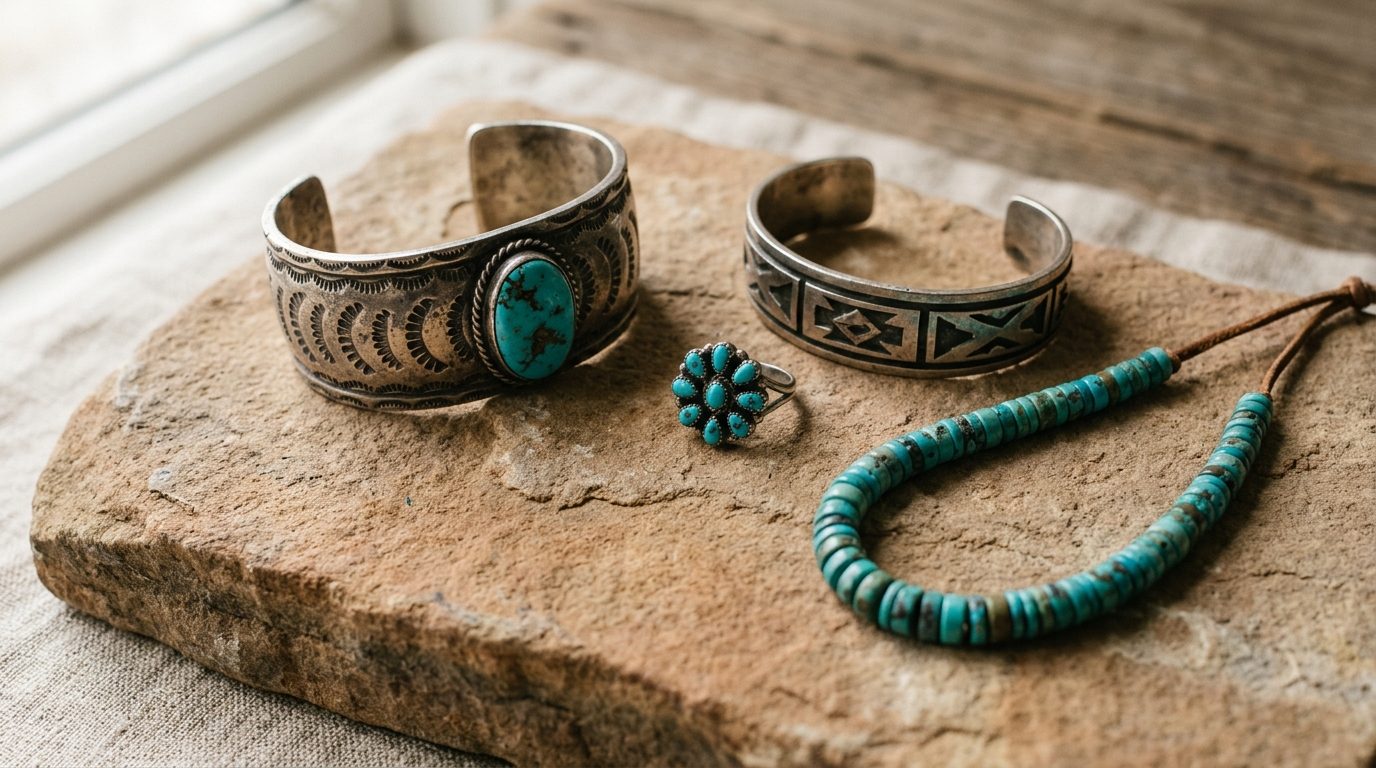
Navajo, Zuni, or Hopi? A Collector’s Guide
When you hold a piece of vintage Southwestern silver in your hands, you are holding more than polished metal and natural stone. You are touching an artistic lineage shaped by regional geography, cultural heritage, and generations of master craftspeople.
For collectors, one of the greatest pleasures is learning to decipher the visual language of these pieces. While cross-pollination and individual artistic innovation have always existed across the American Southwest, distinct tribal traditions developed characteristic techniques that remain unmistakable once you know what to look for.
Whether you are browsing an estate sale, examining an heirloom, or studying a piece in our gallery, this guide will help you identify the hallmarks, metalwork methods, and lapidary styles of Navajo, Zuni, Hopi, and Santo Domingo jewelers.
Navajo (Diné): The Architects of Silver and Stone
Navajo artisans were the first Native metalsmiths in the Southwest, learning the craft from Mexican plateros (silversmiths) in the mid-nineteenth century. Atsidi Sani, often credited as the first Navajo silversmith, began working silver around 1868, later teaching the craft to his brothers and sons.
Because of this origin, Navajo silverwork has always celebrated the weight, structure, and presence of the silver itself. While turquoise is deeply revered, the metal is never merely a backdrop—it is an equal partner in the design.
Key Characteristics of Navajo Silverwork:
- Heavy Gauge Silver: Navajo pieces typically possess a satisfying heft. Early cuffs and concho belts were forged from melted silver coins and ingots, establishing a preference for substantial metal.
- Expressive Stampwork: Hand-made steel stamps, often crafted from old files or railroad spikes, are used to strike intricate geometric patterns, sunbursts, arrows, and scallops into the silver sheet.
- Repoussé and Chasing: Artisans push the silver outward from the back to create raised domes, blossoms, or ribbed elements that catch the light.
- Tufa and Sand Casting: Molten silver is poured into hand-carved volcanic tufa stone or compacted sand molds. The resulting jewelry carries a unique, organic, subtly textured surface that cannot be replicated by modern casting.
- Sawtooth Bezels and Twisted Wire: Navajo stones—often large, freeform cabochons showcasing the natural matrix of mines like Bisbee, Royston, or Morenci—are traditionally held by hand-cut sawtooth bezels and accented with twisted sterling rope or silver raindrops (shot).
If a piece feels bold, architectural, deeply stamped, and built around the organic contours of a natural turquoise nugget, you are most likely admiring Diné craftsmanship.
Zuni (A:shiwi): The Masters of Lapidary Precision
While the Navajo taught silversmithing to the Zuni Pueblo around 1872, the Zuni people brought thousands of years of prehistoric stone-carving and shell-working expertise to the table. As a result, Zuni jewelry evolved in a completely different direction: silver became the structural armature, while the lapidary work—the cutting and setting of stones—became the undisputed star.
Zuni artisans work with incredible patience and microscopic precision, shaping turquoise, Mediterranean coral, mother-of-pearl, and jet into delicate, perfectly matched arrangements.
Key Characteristics of Zuni Silverwork:
- Needlepoint: Stones are hand-ground into slender, pointed ellipses on both ends. Each stone is set into its own individual, tiny silver bezel, arranged in radiating sunbursts, floral medallions, or rows.
- Petit Point: Similar to needlepoint, but the stones are teardrop-shaped, oval, or pointed on only one end.
- Cluster Work: Groups of matched round or oval cabochons arranged in concentric circles or elaborate cuffs, often called blossom or snowflake clusters.
- Channel Inlay: Stones are precisely cut to fit between raised silver divider wires (channels), creating a smooth, flush surface of mosaic color.
- Mosaic and Stone Carving: Flat inlay depicting cultural figures like the Sunface, Rainbow Man, or Knifewing, as well as carved stone animal fetishes (bears, birds, badgers) strung into multi-strand necklaces.
When you see dozens—sometimes hundreds—of minute, matched stones set in delicate bezels, you are witnessing the world-renowned lapidary mastery of the Zuni Pueblo.
Hopi: The Art of Shadow and Silver Overlay
Unlike Navajo stampwork or Zuni lapidary clusters, traditional vintage Hopi jewelry rarely features stones. Instead, Hopi silverwork is celebrated for its clean, graphic, and deeply symbolic metal-on-metal technique known as silver overlay.
Developed in the late 1930s and refined at the Hopi Silvercraft Cooperative Guild after World War II, this method allowed Hopi smiths to translate ancient pottery designs, petroglyphs, and textile patterns into modern jewelry.
Key Characteristics of Hopi Silverwork:
- The Two-Sheet Overlay Technique: A Hopi piece begins with two identical sheets of sterling silver. The jeweler uses an ultra-fine jeweler's saw to hand-cut a negative design into the top sheet. This top layer is then sweat-soldered onto the solid bottom sheet.
- Textured and Oxidized Backgrounds: The exposed areas of the bottom sheet are hand-textured using a fine chisel or matting tool, then treated with liver of sulfur to turn the background deep charcoal black. The top layer is buffed to a brilliant satin or mirror polish.
- High Contrast and Storytelling: The contrast between bright polished silver and the dark, textured recesses creates dramatic visual depth. Common motifs include the water wave, clan symbols, cornstalks, bear paws, Kokopelli, and stylized kachina figures.
If you find a sleek, sculptural piece of silver with intricate cutout designs, a blackened textured base, and no stones, it is almost certainly Hopi overlay.
Santo Domingo (Kewa): Ancient Ancestral Heishi and Shell
Located along the Rio Grande, Santo Domingo Pueblo (Kewa) has maintained the oldest continuous lapidary tradition in North America. Long before silver was introduced to the continent, Kewa artisans were trading hand-rolled stone and shell beads across vast indigenous networks.
Key Characteristics of Santo Domingo Jewelry:
- Heishi (Hee-shee): Translating to 'shell' in Keresan, heishi refers to smooth, disc-shaped or tubular beads. Artisans hand-drill, string, and roll turquoise, olive shell, spiny oyster, and melon shell against sandstone grinders until the entire strand forms a silky, flexible cylinder.
- Shell Mosaic Inlay: Traditional pendant necklaces (Jaclas) and teardrop pendants crafted by inlaying raw turquoise, jet, and shell fragments directly onto backing materials like mother-of-pearl or spiny oyster valves.
- Depression-Era Ingenuity: During the 1930s, when silver and stones were scarce, Kewa makers crafted mosaic jewelry using turquoise scraps backed on found materials like black phonograph records and red Bakelite automotive battery casings. Today, these 'Depression necklaces' are prized museum and collector pieces.
Quick Identification Guide
| Style / Pueblo | Primary Medium | Key Visual Clues | Dominant Techniques |
|---|---|---|---|
| Navajo (Diné) | Heavy Sterling Silver | Substantial cuffs, large natural stones, deep stamping | Stampwork, repoussé, tufa casting, wirework |
| Zuni (A:shiwi) | Turquoise, Coral, Jet, Shell | Delicate, complex patterns with dozens of tiny stones | Needlepoint, petit point, channel inlay, cluster |
| Hopi | Sterling Silver (No stones) | Cutout geometric motifs with blackened backgrounds | Double-sheet silver overlay, chiseled texturing |
| Santo Domingo (Kewa) | Natural Shell & Stone | Flexible rolled beads, mosaic slabs, jaclas | Hand-rolled heishi, organic slab mosaic |
The Joy of the Collection
While these distinctions offer a clear foundation, Native American silverwork is a living, evolving art form. Navajo artists occasionally create exquisite inlay; Zuni smiths produce stunning heavy silverwork; contemporary masters blend centuries-old techniques with avant-garde sculpture.
When evaluating vintage pieces, look closely at the reverse side for artisan hallmarks, shop marks, or guild stamps (such as the Hopi Guild sun mark). Appreciate the natural softening of the silver's edges and the deep patina settled into stamped grooves.
Every piece of vintage Southwestern jewelry tells a specific story of cultural pride, technical ingenuity, and individual vision. When you learn to read the silver, you connect directly with the maker who sat at the bench decades ago, turning raw metal and earth into wearable art.
Related Reading
 Provenance Stories
Vintage Southwestern Silver: Navajo, Zuni & Hopi
Learn to identify authentic vintage Southwestern jewelry. Explore Navajo stampwork, Zuni inlay, Hopi overlay, and Kewa heishi in our collector's guide.
 Provenance Stories
Beyond Turquoise: Southwestern Gemstones & Shells
Explore vintage Southwestern jewelry beyond turquoise. Discover the history and artistry of spiny oyster, jet, sugilite, and rare lapidary materials.
 Care Guides
Real vs. Fake Turquoise: Spotting Authentic Stones
Learn how to spot genuine turquoise in vintage jewelry. Explore matrix cues, luster, weight, and safe at-home tests to identify real vs. imitation stones.