
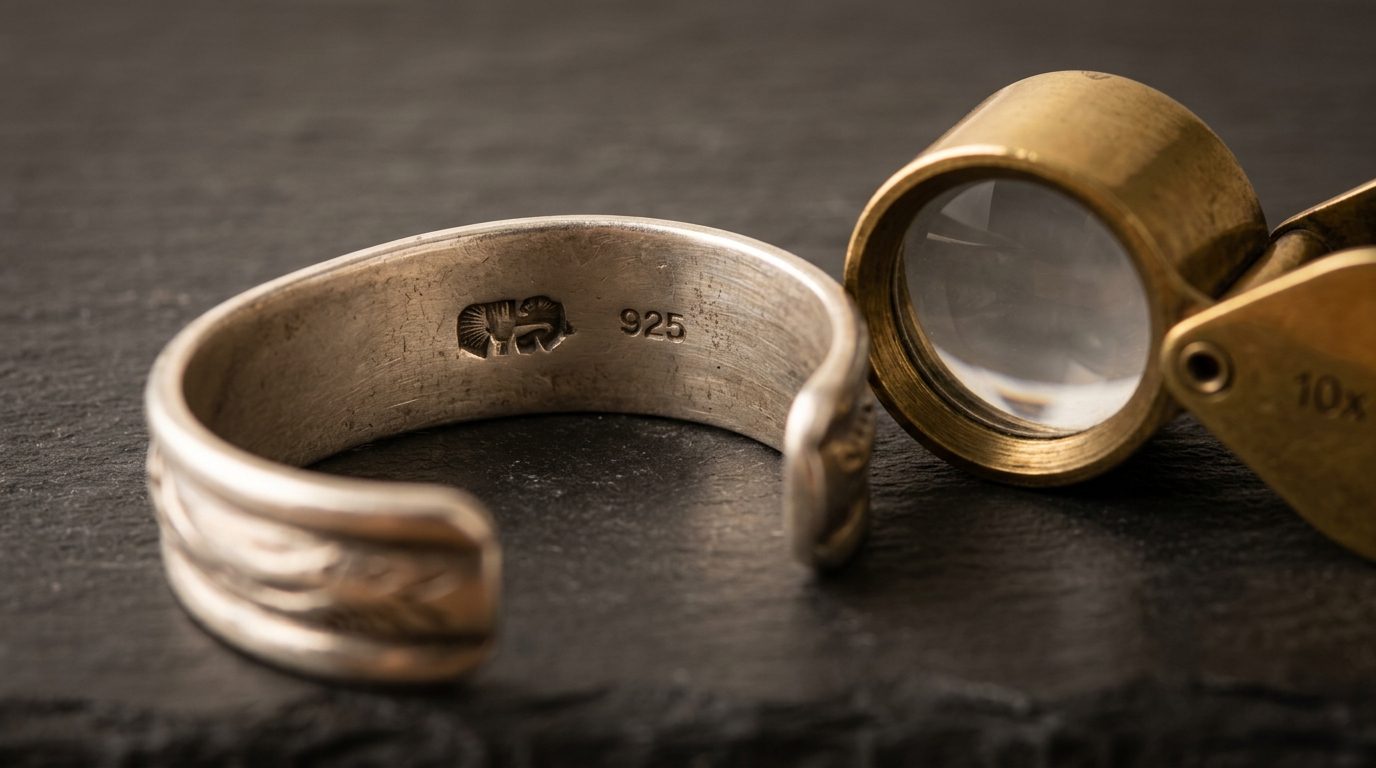
Decoding Vintage Silver Hallmarks & Artisan Stamps
There is a quiet, ceremonial magic in turning a piece of vintage jewelry over in your hands. Beneath the glossy polish or deep indigo patina of the underside, tucked away near a bezel or along the inner curve of a band, you will often find tiny, deliberate impressions in the metal. To the uninitiated, these tiny symbols, initials, and numbers might look like nothing more than random scratches or decorative flourishes. But to those who know how to read them, hallmarks are the whispering voices of history.
A hallmark is a metal object's passport. It tells us where a piece was made, who shaped it with their hands, and the exact purity of the precious metal used in its creation. Whether you are holding a mid-century Scandinavian modernist ring, a heavy Taxco sterling link necklace, or a historic Southwestern turquoise cuff, understanding how to decode these marks unlocks a deeper, richer relationship with the treasures you wear.
Purity Marks: The Standard of Metal
Before an artisan signs their name to a creation, the metal itself must be verified. Purity marks are the most common stamps you will encounter on estate and vintage jewelry, serving as an official guarantee of the alloy's silver content.
In sterling silver jewelry, the global benchmark is 92.5% pure silver, combined with 7.5% trace metals—usually copper—to impart strength to an otherwise soft metal. The standard marks for this alloy include:
- 925 or .925: The numerical representation of sterling silver composition. This is the most widely used international purity mark today.
- STERLING, STER, or STG: Common on American pieces crafted throughout the late 19th and 20th centuries.
- COIN or 900: Frequently seen in older Southwestern Native American jewelry crafted prior to the mid-20th century, as well as early historic pieces. Artisans often melted down silver coins (which were 90% silver) to craft wire, sheet, and bezels.
- 950 or 980: Higher silver purities often found in pre-1950s Mexican silver from Taxco or early Scandinavian pieces. These alloys are softer, slightly whiter in tone, and tarnish at a different rate than standard sterling.
In British sterling, purity is traditionally indicated by a pictorial symbol rather than a number—most famously the Lion Passant (a walking lion with one paw raised), which has guaranteed sterling purity in England for hundreds of years.
Artisan Stamps: The Personal Signatures
The maker's mark, or artisan stamp, is where provenance becomes personal. Unlike commercial jewelry produced en masse in modern factories, hand-crafted vintage pieces carry the distinct signature of the individual bench jeweler or workshop.
Maker's marks come in many forms:
Initials and Names
Many artisans simply used their initials (such as A.J. or T.B.) or their full last name stamped in crisp block letters. In Southwestern jewelry, you might find iconic stamps like J. Nelson for Navajo master silversmith Tommy Nelson or C. Begay representing one of the renowned Begay family smiths.
Pictographs and Symbols
Some of the most captivating hallmarks are pictorial symbols chosen by the artisan to represent their name, clan, or artistic identity. A tiny stamped sunburst, an arrow, a bear paw, a roadrunner, or a turtle can point directly to a master silversmith. For instance, the legendary Hopi jeweler Charles Loloma often used a stylized water symbol, while Hopi Guild pieces carry distinct animal and clan pictographs carved into the silver overlay.
Monograms and Logos
Mid-Century Modernist masters and studio jewelry artists often developed stylized logos. Taxco silver pioneer William Spratling famously marked his pieces with an interlocking WS print surrounded by text, while the famed Mexican designer Antonio Pineda utilized a stylized crown mark alongside his name.
Guild Marks and Regional Registration Systems
In specific regions celebrated for silverwork, organized guilds and federal regulations created distinct hallmark systems that help us pinpoint the precise era a piece was created.
Mexican Silver Stamps (Taxco & Beyond)
Mexico’s rich silver traditions offer a fascinating roadmap of hallmark evolution:
- Pre-1948: Pieces were often simply stamped STERLING, 925, or MADE IN MEXICO, along with the artist's signature or workshop location (e.g., TAXCO).
- 1948 to late 1970s: The Mexican government introduced the Eagle Stamp system—a small silhouette of an eagle containing a number inside its body. The number designated the region or specific workshop responsible for the piece (for example, Eagle 3 is heavily associated with Taxco master Hector Aguilar).
- Post-1979: Mexico transitioned to an alphanumeric registration system. You will often see a letter indicating the location (e.g., T for Taxco, M for Mexico City), followed by the artist's initial and their unique registration number (such as TM-90 or TC-14).
The Hopi Silvercraft Guild
Formed in the late 1940s to support Hopi artists working in the distinctive silver overlay technique, the Hopi Silvercraft Guild marked certified pieces with a stamped Sun Shield symbol. Finding this mark alongside an artisan's personal pictograph is a hallmark of exceptional mid-century indigenous craft.
The Jeweler’s Toolkit: How to Inspect Your Pieces
Decoding silver stamps is an art that requires patience and a few simple tools. If you want to explore the history hidden within your own collection, consider building a simple inspection kit:
- A 10x Jeweler's Loupe: Small stamps are often struck lightly or worn down by decades of love. A decent 10x magnification loupe will bring faded initials and delicate pictographs into sharp focus.
- Raking Light: Hold your jewelry at a shallow angle under a bright, directional lamp. Angled lighting creates micro-shadows inside the recessed impressions of a stamp, making faint lettering far easier to read.
- Reference Guides: Provenance research relies on dependable documentation. Essential reference texts like Bille Hougart’s Native American and Southwest Silver Hallmarks or Little’s Old Cowboy Jewelry are invaluable field guides for identification.
The Charm of the Unmarked Piece
As satisfying as it is to clear up a hallmark mystery, it is equally important to remember that the absence of a stamp does not diminish the beauty or value of a vintage piece.
Historically, many Southwestern silversmiths did not sign their work prior to the 1970s, viewing jewelry making as a communal tradition rather than an exercise in personal branding. Other pieces were custom-commissioned or crafted using coin silver melted down at home long before commercial silver stamps became commonplace. In these instances, we look to technique—the precise angle of a hand-chiseled stamp, the depth of a file mark, the natural patina of old turquoise—to tell the story of the maker's hand.
Preserving the Story
When you own a piece of hallmark-verified vintage jewelry, you are not simply wearing an accessory; you are keeping a physical document of human artistry alive. Every stamp tells a story of an artisan standing at a workbench, striking a steel punch into hot metal, leaving behind their mark for generations to come.
The next time you slip on a vintage ring or clasp a heavy sterling cuff around your wrist, take a moment to look closely at its underside. You might just discover a conversation across time waiting to be read.
Related Reading
 Provenance Stories
Vintage Taxco Silver: Masters, Marks & History
Explore the Golden Age of vintage Taxco silver. Learn to decode eagle assay stamps, identify legendary makers, and collect authentic Mexican studio jewelry.
 Provenance Stories
Vintage Southwestern Silver: Navajo, Zuni & Hopi
Learn to identify authentic vintage Southwestern jewelry. Explore Navajo stampwork, Zuni inlay, Hopi overlay, and Kewa heishi in our collector's guide.
 Care Guides
Real vs. Fake Turquoise: Spotting Authentic Stones
Learn how to spot genuine turquoise in vintage jewelry. Explore matrix cues, luster, weight, and safe at-home tests to identify real vs. imitation stones.