
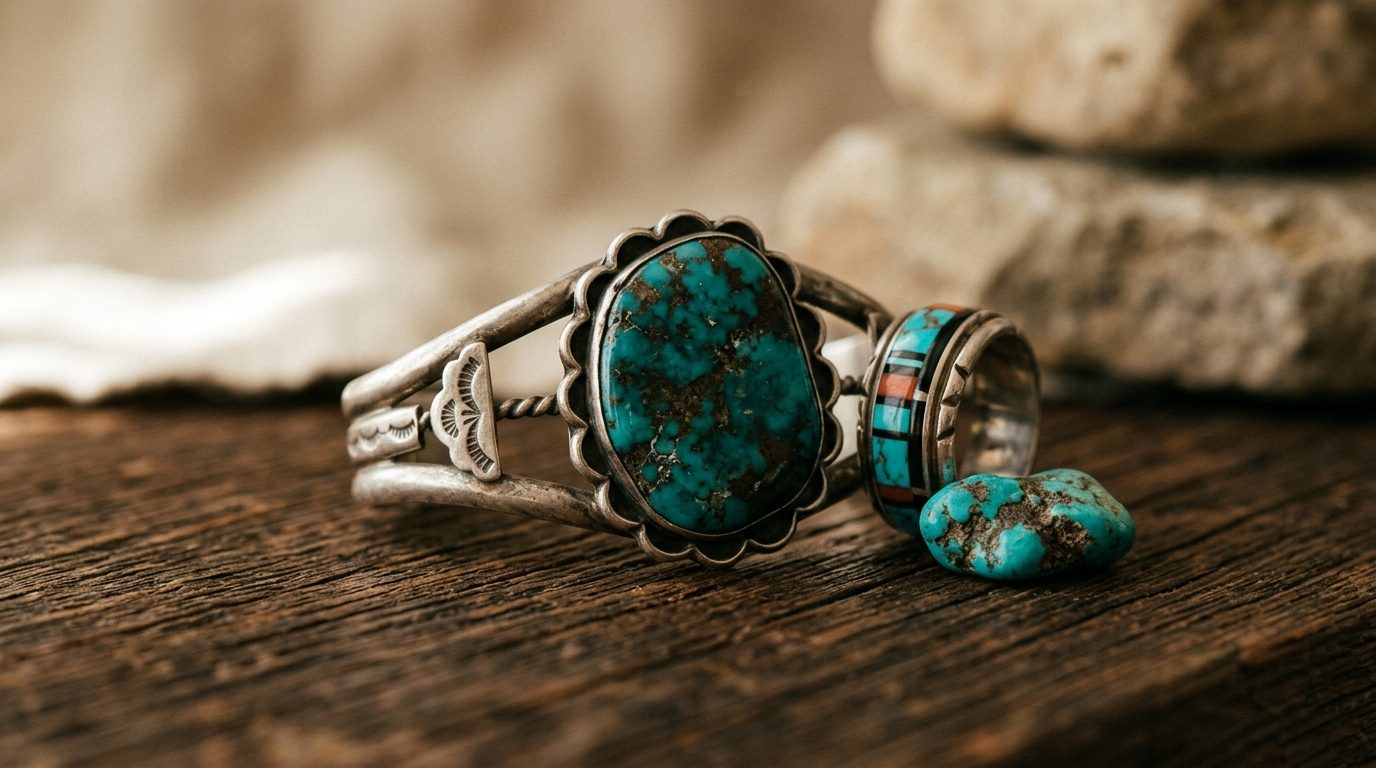
A Collector's Guide to Vintage Southwestern Jewelry
The Living History of Southwestern Silver
There is a quiet, unmistakable magic in holding a piece of vintage Southwestern silver. Run your thumb over the cool surface of a hand-hammered cuff, and you feel the rhythmic weight of a metalsmith’s hammer from decades past. Look closely at a cabochon of turquoise, and you are gazing at mineral deposits formed millions of years ago, shaped by human hands to tell a story of land, culture, and enduring artistry.
For many collectors, Southwestern and Native American style jewelry begins as an appreciation for aesthetics—the striking contrast of bright blue stone against dark, oxidized silver. But as your collection grows, so does your understanding that these pieces are far more than adornments. They are wearable history, bridging indigenous craftsmanship, trade routes across the American Southwest, and the evolution of American studio jewelry.
Whether you are drawn to the heavy, sculptural hand-stamping of early Diné (Navajo) silver, the intricate stone-cutting of Zuni lapidaries, or the sleek graphic precision of Hopi overlay, building a collection is an intentional journey. This guide is designed to help you navigate the rich landscape of Southwestern jewelry with confidence, reverence, and a keen collector's eye.
Understanding the Distinct Regional Traditions
While Southwestern silver is often spoken of as a single genre, it comprises several distinct cultural traditions, each with its own signature techniques, materials, and philosophical approaches to design.
The Bold Sculptural Hand of the Navajo (Diné)
Navajo metalsmiths were the first in the Southwest to adopt silversmithing in the mid-19th century, learning the trade from Mexican plateros. Early Navajo jewelry was functional and bold—cuffs, horse bridles, tobacco canteens, and concho belts forged from melted silver coins.
When evaluating vintage Navajo work, look for:
- Stampwork and Repoussé: Deep, hand-carved steel stamps pounded into cold silver to create repeating geometric motifs, sunbursts, and feathers. Repoussé involves hammering silver from the back to create raised, three-dimensional forms.
- Substantial Silver Mass: Classic Navajo cuffs and rings celebrate the raw weight of sterling. The silver is rarely thin; it feels grounded and structural.
- Cluster and Hub Design: Rows or clusters of turquoise cabochons—often hand-cut teardrops or ovals—arranged in concentric starbursts or frames around a central stone.
The Lapidary Mastery of the Zuni
Where Navajo work emphasizes the manipulation of silver, Zuni jewelry is celebrated for its unmatched stone-cutting and inlay work. To the Zuni artist, silver is primarily a channel or bezel meant to hold finely cut gems.
Key Zuni techniques include:
- Needlepoint and Petit Point: Teardrop or snake-eye turquoise stones hand-cut to minute proportions and individually set into tiny serrated bezels. A single cuff may feature dozens—or hundreds—of uniformly cut stones.
- Channel Inlay: Stones shaped to fit flush within silver grid walls, creating a seamless, smooth mosaic surface.
- Mosaic Inlay: Intricate figurative or geometric images constructed from turquoise, mother-of-pearl, jet, and spiny oyster shell laid closely together without metal dividers.
The Clean Precision of Hopi Overlay
Hopi silversmithing developed its signature style in the mid-20th century, largely encouraged by the Hopi Silvercraft Guild founded in the 1940s. Hopi design relies heavily on clean silver surfaces and symbolic narrative rather than stone setting.
- Overlay Technique: Two sheets of sterling silver are soldered together. The top sheet has a intricate design meticulously cut out with a jeweler's saw. The exposed bottom sheet is then hand-textured with tiny punch marks and chemically oxidized black, creating a high-contrast, graphic illustration.
- Motifs: Hopi pieces frequently feature traditional iconography such as rain clouds, water waves, corn maidens, and stylized wildlife.
The Earthy Harmony of Kewa (Santo Domingo)
Kewa Pueblo artisans are legendary for keeping ancient lapidary techniques alive. Long before silver arrived in the Southwest, Kewa makers were fashioning beads and pendants from stone, shell, and bone.
- Heishi Beads: Tiny, hand-drilled discs of shell or stone strung together to form smooth, flexible cylinders. Genuine vintage heishi flows like silk through the fingers.
- Depression-Era Mosaic: During the 1930s, Kewa artists created striking mosaic jewelry using discarded battery casings, vinyl records, and turquoise chips glued onto gypsum or shell backings—a brilliant testament to resourcefulness and design vision.
Turquoise Demystified: Mines, Matrices, and Character
No discussion of Southwestern jewelry is complete without turquoise. Highly prized for thousands of years as a stone of protection and sky-blessing, turquoise varies dramatically depending on the mineral content of the soil where it formed.
As a collector, learning to recognize classic mine profiles enriches your appreciation for each piece:
- Bisbee (Arizona): Famous for its rich, electric true-blue hue and chocolate-brown or reddish matrix.
- Morenci (Arizona): Highly sought after for its vivid sky blue color paired with striking metallic iron pyrite matrix that gleams like copper or silver.
- Royston (Nevada): Known for vibrant two-tone cabochons that fade seamlessly from bright blue to earthy green within a rich hazel matrix.
- Kingman (Arizona): One of the oldest and largest mines, producing everything from pale robin's egg blue to deep blues with black spiderweb matrix.
- Number 8 (Nevada): Instantly recognizable by its light blue background intersected by an intricate, golden-brown or black spiderweb matrix.
Natural vs. Treated Turquoise
Because natural high-grade turquoise is porous and scarce, much modern commercial turquoise is stabilized with resin to harden the stone and deepen color. While stabilization is standard practice in contemporary fashion jewelry, vintage collectors place a high premium on natural, untreated stone.
Over decades of wear, natural turquoise absorbs skin oils, slowly shifting in color from sky blue to deep green. This color change is not a defect—it is a cherished badge of age, authenticity, and personal history.
Hallmarks, Stamps, and Verification
Identifying vintage Southwestern jewelry requires both technical knowledge and intuition. Unlike European silver with its strict hallmarking guilds, Southwestern silversmiths did not consistently mark their work until the mid-to-late 20th century.
- Pre-1930s: Most pieces are completely unhallmarked. Silver was often melted down from US or Mexican silver coins (typically around .800 to .900 purity).
- 1930s–1970s: Makers began using initial stamps, pictorial stamps (such as an arrow, bear, or sunburst), or shop trademarks used by trading posts (like Fred Harvey or Bell Trading Post).
- Post-1970s: Full name hallmarks and explicit
.925orSTERLINGstamps became standard as federal regulations and collector demand increased.
When evaluating unsigned vintage pieces, look at the construction details: hand-cut bezels, irregular saw marks on the backplates, file marks along the edges, and natural wear patterns where silver met skin.
The Stewardship of Patina
One of the most common dilemmas for new collectors is whether to polish vintage silver. At KayBen Treasures, our philosophy is clear: preserve the patina.
Decades of natural oxidation settle deep into stampwork, coin edges, and bezel walls, providing three-dimensional depth and contrast that factory-applied oxidation simply cannot replicate. Over-polishing or using liquid chemical dips removes this irreplaceable history, stripping the piece of its soul and often stripping away valuable market valuation.
To care for your collection:
- Wipe silver gently with a soft micro-fiber or treated silver polishing cloth—never dip in harsh chemical cleaners.
- Keep natural turquoise away from soaps, perfumes, hand sanitizers, and ultrasonic cleaners.
- Store pieces in low-humidity environments, ideally wrapped in cloth pouches to prevent scratching.
Building a Curated Collection
Collecting vintage Southwestern jewelry is not about acquiring as many pieces as possible; it is about building a dialogue between objects that speak to you. A single, perfectly weighted Fred Harvey-era cuff stamped with thunderbirds tells a richer story than a dozen mass-produced modern imitations.
Seek out one-of-a-kind estate finds, honor the history woven into every design, and embrace the small irregularities that prove a human hand guided the tool. When you wear vintage Southwestern silver, you are not just accessorizing—you are keeping a great American artistic tradition alive and moving forward.
Related Reading
 Provenance Stories
Vintage Southwestern Silver: Navajo, Zuni & Hopi
Learn to identify authentic vintage Southwestern jewelry. Explore Navajo stampwork, Zuni inlay, Hopi overlay, and Kewa heishi in our collector's guide.
 Provenance Stories
Navajo, Zuni, or Hopi? A Collector’s Guide
Learn how to identify vintage Navajo, Zuni, Hopi, and Santo Domingo jewelry through traditional lapidary arts, silver overlay, stampwork, and hallmarks.
 Style
StyleThe Lasting Charm of Estate Jewelry Over Fast Fashion
Discover why vintage and estate jewelry offers superior craftsmanship, unique character, and sustainable luxury that mass-produced fast fashion can't match.