
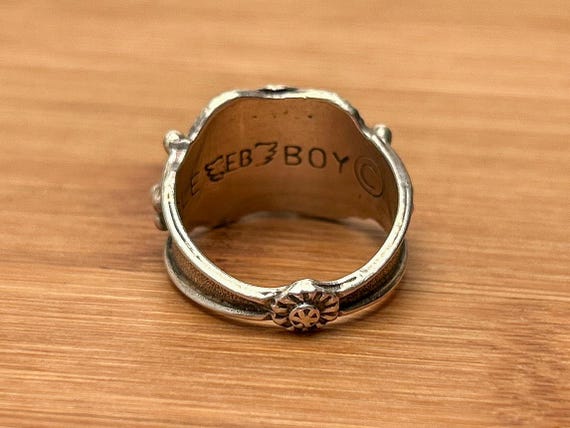
EAGLE BOY
- Maker
- Royce Kohlmeyer attributed, not confirmed
- Struck in
- Jemez Pueblo, New Mexico attributed, not confirmed
- Recorded on
- 1 piece
The "EAGLE BOY" stamp is the maker's mark of Royce Kohlmeyer (Royce "Eagle Boy" Kohlmeyer), a jeweler from Jemez Pueblo, New Mexico. The mark is struck in clear, uppercase block lettering and is frequently accompanied by his signature eagle wings pictogram, the initials "EB", and a standard sterling purity stamp.
Kohlmeyer's work typically demonstrates refined silver overlay techniques, heavy-gauge fabrication, and fine lapidary settings featuring natural Southwestern turquoise, such as Carico Lake. His aesthetic integrates traditional Jemez Pueblo artistic concepts with classic Navajo silversmithing methods, often utilizing balanced geometric cuts and tapered shank constructions.
This mark is easily distinguished from mid-century Mexican eagle assay stamps (which consist of a stylized eagle containing a number) and standalone avian pictographs used by various Hopi or Navajo artisans by the literal stamped text "EAGLE BOY" stamped alongside the wing emblem.
Previously sold with this mark
Kept on the record — a maker's back catalogue is most of the evidence that a mark is what we say it is.
If your piece also carries a Mexican assay mark, here is how to date it
Mexico ran two systems and which one a piece carries is itself a date. An eagle's head in profile with a number inside it was compulsory from 1948 and discontinued in 1979, so an eagle puts the piece inside that span. The eagle was drawn in outline until about 1955 and as a solid silhouette after, which narrows it further.
From 1979 the eagle was replaced by a letter-letter-number registry mark that is still in use — TL-67, TF-24. The first letter is the town: T for Taxco, M for Mexico City, G for Guadalajara, C for Cuernavaca. The second is the first letter of the silversmith's surname, and the number is their place in that town's register.
The number does not name the maker on its own. Matching a registration to a person takes the register, and collectors have spent decades doing it one entry at a time. Where we cannot say whose it is, this index says so rather than guessing.
| Struck | Means |
|---|---|
| An eagle mark, any number | 1948–1979 |
| TL-67 | After 1979; Taxco, surname beginning L |
What this entry is based on
- one piece carrying this mark, handled and photographed by this shop Written with the piece in hand. No published hallmark reference covers most of these marks.
Nothing outside this shop has been checked for this mark yet. What is above comes from the pieces themselves and from what was written while they were in hand.
Know something we don't about this mark? Tell us — corrections from collectors are how a reference like this gets better.